Monday, April 5, 2010

Covalent bonding

Covalent Bonding
- Electrons are shared between non-metals
- Drawing the Lewis Dot Diagrams:
  1. Total all valence electrons in all atoms
  2. Identify the element that can form the most bonds. This will be the central atom.
  3. Draw bonds between atoms as a line. This represents 2 e-
  4. Any e- not part of a bond are lone pairs around the atom
  5. Check to make sure each atom has a full octet

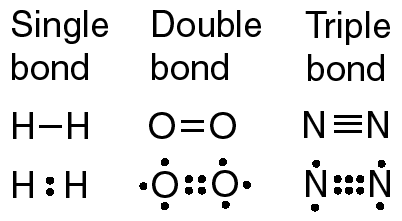
Double & Triple Bonds
- Some compounds form more than one bond between two elements


Okay, YEESh.
Timmme for a much needed break from chem with some soothing tunes from the Beatles!

Atoms & Ions

- Atoms are electrically neutral
- # of protons = # of electrons
- Ions have different # of protons and electrons
- Ions can be either positive (lose e) or negative (gain e)
- cation = positive ion
- anion = negative ion

Example:
C4-
Carbon gains 4 electrons and it is an anion.

CHEMICAL BONDS
- A bond is an electrostatic attraction between particles.
- Bonds occur as elements try to achieve Noble gas electron configuration
- Noble gases (usually) don't form compounds or bonds
- In Noble gases, the outermost energy level have stable octects.
- Metals lose electrons (oxidize)
- Non-metals gain electrons (reduced)

LEWIS DOT STRUCTURE
- Atoms can be represented by dot diagrams
- Dots represent electrons
- Only valeance level electrons are shown
- The atomic symbol for the atom represents the nucleus and filled inner electron levels
- One dot is used to represent outer energy level electrons

** Some helpful info:
http://www.ausetute.com.au/lewisstr.html


IONIC BONDS

- Electrons are transferred from metal to non-metal
- No dots are shown on metal
- 'Charged' species is written in brackets

Na + Cl → Na+ + Cl− → NaCl

Group projects / presentation topics

  • Mendeleev's Periodic Table
  • Metals
  • Non-metals
  • Metalloids
  • Trends n Physical Properties of Elements on the Periodic Table
  • Trends in chemical properties of elements on the periodic table (ion charge, chemical reactivity, ionization energy)
  • Properties of Alkalis, Alkaline Earth Metals, Halogens, Noble Gases and Transition Metals

Atomic Weight [ jojojoojojoanneanneanne]

Example: Silver


The atomic weight for silver is 107.9. in the last example we saw the atomic number of silver was 108. This is because there are more than 1 isotope of silver and some are lighter than others

Atomic Structure / Isotopes [Joanne]

Emission Spectra
- Each element guves off a specific colour of light.
- These are known as emission spectra, unique to each element
- If electrons absorb energy they can be bumped to a higher level
- When they fall to a lower level they release that energy as light

Atomic Structure
- Atoms are made up of parts called subatomic particles
- Protons (positive), Neutrons (neutral), and Electrons (negative)

Atomic Number
= number of protons


A =
atomic number
B = Ion charge
C = Symbol
D = Element name
E = Atomic Mass


Isotopes
- The number of protons determine the type of element
- Changing the number of neutrons changes the isotops of the elements
- All isotopes have the same chemical properties

Mass Number
- Mass number is the total of protons and neutrons
- Symbol given is A
- Different isotopes have different masses
- Mass number = atomic number + number of neutrons
A = Z + N

Ex. Boron:
Isotope - 11
Mass - 11
Atomic # - 5
Protons - 5p
Neutrons - 6n

Ex. Nickel
Isotope - 59
Mass - 59
Atomic # - 28
Protons - 28p
Neutrons - 31n

Bohr Models [ Joanne ]

number of electrons = number of protons in a neutral atom
number of neutrons = atomic mass - the number of protons.
***

- Atoms are electrically neutral
- Two different models can be used to describe the electron configuartion:
1.) Energy Level Model
2.)
Bohr Model

BOHR MODEL
Electrons occupy shells which are divided into orbitals
2e in the first Orbital
8e in the second orbital
8e in the third orbital
(the ones with the 8e are called Octet)

Ex. Aragon (Energy level Model)
8e- 3rd level
8e- 2nd level
2e- 1st level

40 <---atomic mass 18 Ar <---- atomic number / number of protons

Bohr model of Argon

____________________________________________


Ex. Chlorine (Energy Level Model)

7e- 3rd level
8e- 2nd level
2e- 1st level

35
1 Cl


Chlorine (Bohr Model)

___________________________________________

Ex. Fluorine (Energy Level Model)

7e- 2nd level
2e- 1st level

19
9 F


Flourine (Bohr Model)

_____________________________
_____________________________

Hybridized orbitals

- The first of the bohr levels is the 1st orbital and it holds only 2e
the second level contains the 2s, 2px, 2py, 2pz orbitals. they combine (hybridize) to form one 2sp3 orbital

***


"OH MY GOSH,OH MY GOSH,
OHHHH MY GOSH !!!!!!
"


Atomic Theory [Joanne]

Early Atomic Theory
-GREEK
- In 300 B.C., Democritus said atoms were invisible particles,
- First mention of atoms (atomes)
- Not a testable theory, only a conceptual model
- No mention of any atomic nucleus or its constituents
- Cannot be used to explain chemical reactions
- This theory was the most accepted view for over 2000 years


____________________________________________

Lavoisier (late 1700s)
- Law of Conservation of Mass
- Law of definite proportions
- Wasn't a true atomic theory because it didn't discuss what atoms were arranged

____________________________________________

Proust (1799)
- If a compound is broken down into its constituents, the products exist in the same ratio as in the compound
- Experimentally proved Lavoisier Laws

____________________________________________

Dalton (early 1800s)
- Atoms are solid, indestructible spheres (like Billard balls)
- Provides for different elements (these would be different spheres)
- Doesn't metntion subatomic particles
- Can't explain isotopes
- Didn't mention the nucleus


___________________________________________

J.J. Thomson (1850s)
- Raison Bun Model
- Solid, positive spheres, with negative particles embedded in them
- First atomic theory to have positive (protons) and negative (electrons) charges
- Introduces idea of nucleus
- Didn't mention neutrons, so radioactive decay could'nt be explained
- Doesn't explain how electrons can exist outside nucleus
- Doesn't explain electrons role in chemical bonding


_________________________________________

Rutherford (1905)
- Showed that atoms have a positive, dense center with electrons outside it
- Resulted in a planetary model
- Explains why electrons spin around the nucleus
- Suggests atoms are mostly empty space
- Didn't mention neutrons
- Doesn't explain valence level electrons role in chemical bonds

__________________________________________

Bohr (1920s)

- Electrons MUST only exist in specific orbitals around nucleus

- Explains how valence elctrons are involved in bonding

- Explains the difference between ionic and covalent bonding

- Resolve the neutron (discovered in 1932)

- Explains atomic emission spectra


***

Here's a random video of an unusual singer from Filipina's got talent....